
Written by: Rachel Lee, FCSN Voices Editor
Graphics by: Karen Gong, FCSN Voices Senior Graphic Artist
Sherry Meng is the founder and owner of Turtleworks, a small embroidery business that employs young adults with special needs. When her son was diagnosed with autism at the age of three, Meng found immense support at FCSN, which inspired her to give back to the FCSN community. In 2009, she began to volunteer with FCSN and served as the South Bay Enrichment Program director, creating about 20 programs. Additionally, Meng has taught vocational skills applicable to various workplaces, including offices, schools, restaurants, stores, and laundries.
Background & Initiative
For the past 15 years, Sherry Meng has devoted her time as a volunteer and program leader at FCSN, where she has taught students with special needs a wide range of practical skills. However, she soon realized that her students lacked the experience of working for a real business. As an educator, Meng wanted to determine what skills the job market seeks in individuals with special needs and how to then train them effectively for the job. “[At] that time, I told my husband, ‘I really need to create a real business. Then I can know how [to] train them [and] how [to] teach them,’” Meng said. She recognized that despite significant government funding for the special needs community, there remained a shortage of job opportunities for individuals with special needs. As a parent, Meng was driven to create a supportive working environment where children like her own could gain meaningful employment opportunities and job training.
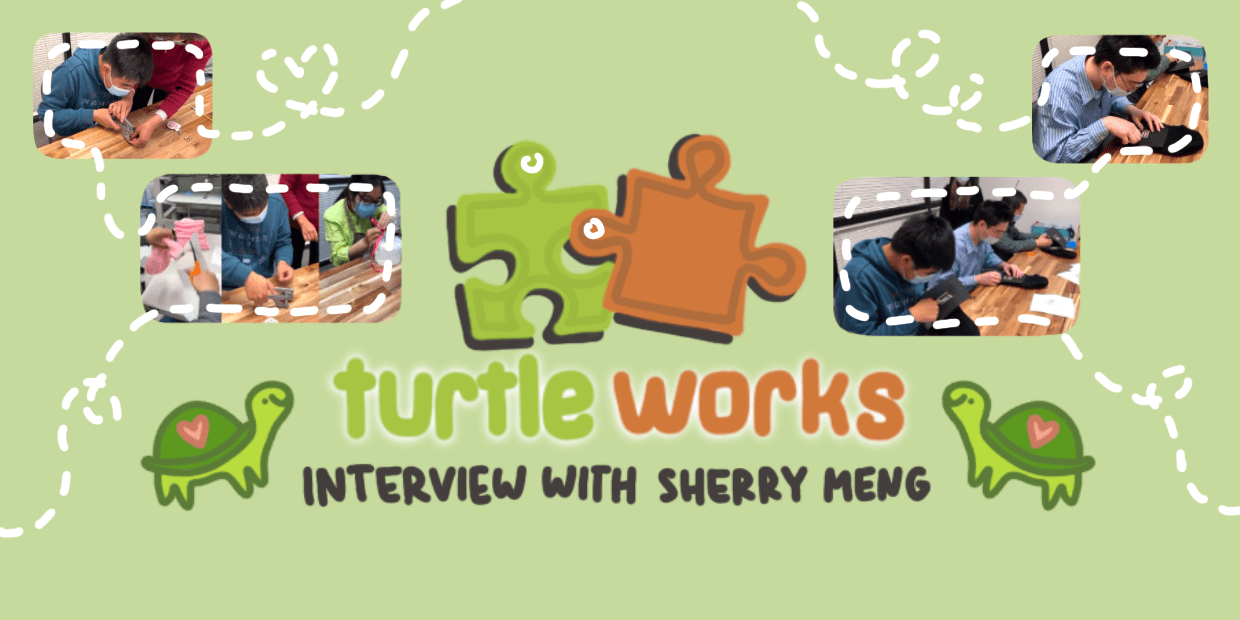
In 2020, Meng founded Turtleworks, which aims to provide individuals with special needs the opportunity for stable employment and valuable working experience. This small business creates a supportive environment with jobs catered towards each employee’s capabilities, strengths, and talents. Moreover, the job training provided at Turtleworks prepares employees for future work opportunities beyond Turtleworks. Turtleworks occasionally collaborates with FCSN programs, such as the Adult Day Program, to bring in young adults with special needs to assist in the production process.
One key aspect of Turtleworks’ initiative is teaching people with special needs the expectations of a professional workplace. For example, there is a specific method for folding clothes when serving a customer, which is different from how laundry is done at home. “In a real business, if your quality [is] not good [or] you cannot [deliver] on time…you won’t have a business, so whatever we do, we really set the bar very high,” Meng said. “[Customers] can judge you if you don’t do a good job, so we keep a very high standard for quality.”

Recognizing Special Needs
Meng decided to center her business around embroidery as individuals with special needs are often “very detail-oriented and also very visual.” She also believes that work involving computers can help them develop valuable skills in the modern world. Additionally, embroidery can be subdivided into smaller jobs that accommodate students at different skill levels, and it does not require extensive interaction with people, which is a challenge for many individuals with special needs.
The name of the business, Turtleworks, is a reference to the story of the tortoise and the hare. Meng relates children with special needs to little turtles: although it may take them longer than other kids to learn and succeed, Turtleworks empowers them to emerge from their shells, slowly and steadily achieving their goals. The business logo features two puzzle pieces that symbolize autism as many people lack the understanding and are puzzled by topics surrounding special needs. Additionally, like puzzle pieces fitting perfectly together, Turtleworks employees each contribute their time and effort to the embroidery pieces, learning to collaborate in creating a beautiful final picture.

Employee Training
Interestingly, Turtleworks begins training new employees by educating them on the final steps of the production line. “[For] the first step, we always do the last step for embroidery production,” Meng said. “During that step, the basic skill is cutting or trimming, folding, counting, and packaging. Also, when they are working, we focus on their working attitude – [reliability], efficiency, troubleshooting, asking questions, and [meeting] the guidelines.” Early exposure to these final steps not only eases new employees into the embroidery production process and workfield, but also enables them to recognize what the desired end product should look like, preparing them to identify errors at earlier stages in the future.
After passing these steps, employees learn how to use a needle and thread as well as how to load and unload garments onto an embroidery machine. Then, they are trained on operating the machinery, performing maintenance, and troubleshooting. Once proficient, they learn to modify a customer’s design with a special software. Finally, employees are trained in utilizing online marketing tools, maintaining an online store, and interfacing with customers.

Inclusivity
To promote an inclusive and supportive environment for each employee, Turtleworks implements a variety of strategies. Meng takes time to understand the individual strengths and weaknesses of each employee, and for those working regularly, she reserves specific tasks for them based on their strengths. Additionally, employees are trained across multiple stages of production so they each have a chance to get involved.
Accommodations are made based on unique learning styles, sensory sensitivities, and emotional needs. “[It’s] really based upon their learning style, so we sometimes show them how [to] do it, probably [using] a picture,” Meng said. “Sometimes, we just write simpler instructions, so hopefully, they can [easily] follow.” Additionally, Meng tries to break large tasks into smaller parts and offer shorter work shifts. Her team provides individualized attention for each employee through one-on-one guidance along with plenty of encouragement. “A lot of special needs parents, when their children go to work…worry about [bullying] and discrimination, so we guarantee we…always treat them nicely and safely,” Meng said.

Impact
Through their beautifully embroidered creations, Turtleworks has not only delighted customers but also transformed the lives of its employees. “This job is pretty special. Every time you finish the job, you can see exactly what you worked [on],” Meng said. “When customers pick up the job, they say, ‘Wow, it’s so good,’ and [the employees] feel really good…so I feel like this is developing a motivation to do work and do better work.”
Over the past four years, Turtleworks has fostered personal growth among its employees, helping them achieve greater fulfillment in their lives. For instance, one young employee joined Turtleworks because she had nowhere else to go after graduation. Initially, she worked two-hour shifts for two or three days a week, and then she gradually increased her hours and number of workdays. After about three years at Turtleworks, she has gained confidence through customer interactions and increased her independence from her work experience. With her earnings from Turtleworks, she even bought a gift for her parents.
Emphasizing the broader purpose of having a job, Meng said, “I keep telling her [we] do work not only for the money. We also want ourselves [to get] better and better each day. Every day we learn a little bit…we can make ourselves better.” Through Turtleworks, Meng offers employment experience and opportunities to individuals with special needs, tailoring an environment where they can learn, grow, and feel valued, one stitch at a time.
 fcsnvoices.org