
Written by: Helen Gu, FCSN Voices Youth Reporter
Graphics by: Olivia Koo, FCSN Voices Senior Graphic Artist
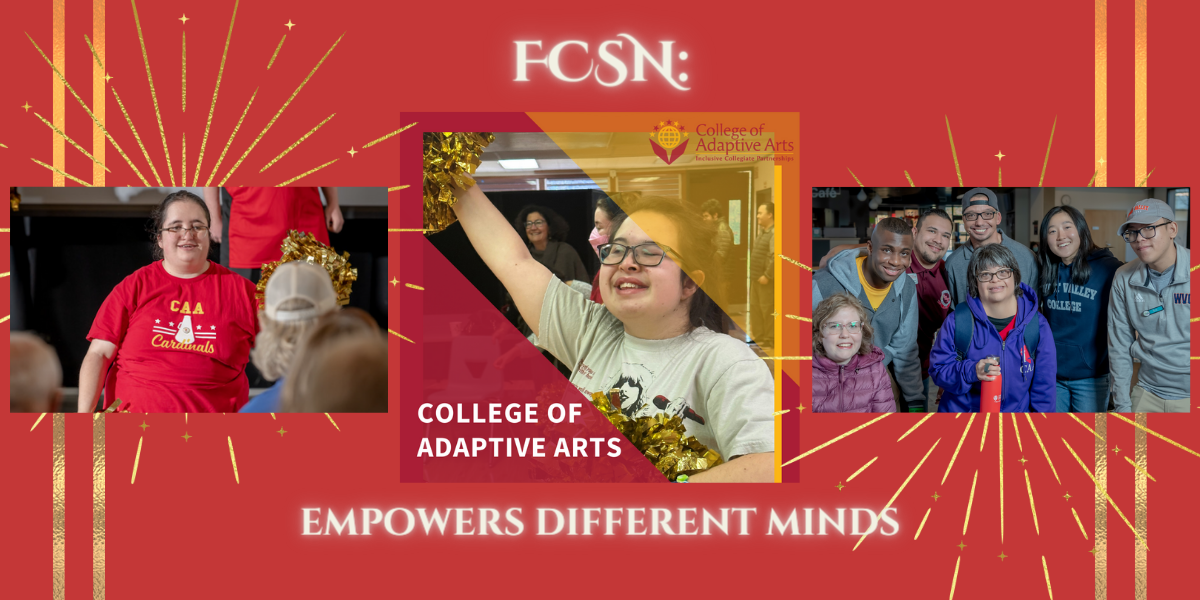
“I realized, in a lot of ways, my sister was more intelligent than me,” DeAnna Purcell, co-founder of the College of Adaptive Arts recalls about her sister. “She never had her full abilities cultivated, honed, or supported properly.” DeAnna’s sister, Angel, was born with Down syndrome, a disorder of the body’s chromosome 21. Throughout her life, all her education has been through the public education system, a system that often isn’t able to fully support students with disabilities and thus, quickly becomes stressful for them. When Angel aged out of secondary school, she had no place that could allow her to continue her education while also providing her with the support she needed.
Angel was DeAnna’s motivation for co-founding College of Adaptive Arts, the first lifelong learning model for adults with disabilities, in 2009. Starting out with just two staff members and twelve students, the program now includes 40 staff and 216 students. “Each of the 216 students have their own path,” DeAnna explains. “Some take one class, and some take fifteen. We all learn together and everybody is supporting each other.” She notes that due to the public school system catering to mostly neurotypical students, many students with disabilities have their talents and abilities overlooked. “The creative and intellectual minds of our students blow me away every day,” she says.
Alan, a student currently enrolled in the program, took online classes at Lydian Academy for a year before enrolling into College of Adaptive Arts. “I’ve always heard of this school because FCSN has lots of families there,” Yvonne, Alan’s mother, recalls. “They did a seminar at one of the family gatherings and it impressed me.” Yvonne states that she “really liked the positive vibes the students provided,” as well as the flexibility the program gave the students.

After Alan completed high school and received his diploma, Yvonne decided to enroll him into College of Adaptive Arts. At first, she was worried about the transition: after taking classes online for several years, she feared that returning to a group-learning environment would be stressful for him. However, that fear soon dissipated. “The moment he stepped into the classroom, he was really happy to be there,” she said.

Unlike traditional higher-education institutions, College of Adaptive Arts’ highly flexible academic structure places more weight on the individual needs of the students. Students have the opportunity to choose which classes they would like to take, how many classes, and whether to attend in-person or online. This way, students can choose all classes they are interested in and spend time learning subjects that they enjoy. “Alan took World History today,” Yvonne says, “and also Spanish, his favorite course. He also took Food Smart, and a class related to technical design.” Right now, Alan has two online classes and two in-person classes, so going to the campus is not a daily activity. The college’s small class size, an average teacher-to-student ratio of one to four, ensures that every student is heard and understood. Along with that, homework is optional and most of the learning is done in the classroom. “We do not require reading; no tests, no papers to write, and they don’t even have to contribute if they don’t want to,” DeAnna adds. “While they do receive diplomas, we encourage them to re-enroll. It’s a lifelong learning model.”
College of Adaptive Arts is currently located in a building on the West Valley Community College. According to Yvonne, the campus is not crowded, noisy, or overwhelming to the students. “I’ve seen students from College of Adaptive Arts walking on the campus and feeling very at home there,” she says. “In the classroom, it’s a wonderful and warm environment where you feel like you’re learning something and still surrounded by all your friends.”


The current campus has been a relatively recent change. “In 2020, we lost our campus due to the building being sold,” DeAnna shares. “West Valley came and took a tour and voted unanimously to let us stay; it was really inspiring and glorious.”
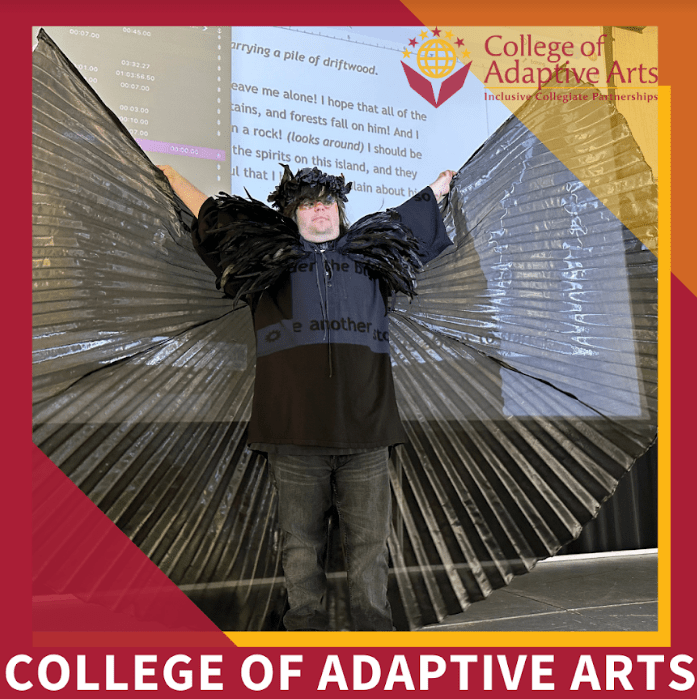
Since then, DeAnna has accumulated many heartwarming memories of the students on the new campus. “We performed The Tempest yesterday,” she said. “I don’t feel like I’m working a day of my life, and I feel like I’m the absolute luckiest person on Earth.” DeAnna says she has always had a dream of bringing this learning model into colleges all over the world. Her goal, she says, is to show how this model could be an extended canopy of every special education institution in the world, “like a special olympics for higher learning.” She wants to make college education possible for those who, historically, have not had the opportunity or access.
Yet, the journey has not always been smooth. “Funding is not easy,” she admits. “We are not fully funded, and there is no code out there for higher education for adults with intellectual disabilities.” Most of the funding for College of Adaptive Arts is through student tuition and donations, and even so, their payment frequently out-paces reimbursement rates. DeAnna often worries about the stability of their learning model, adding that it’s “a tremendous challenge making sure the staff is supported living in one of the most expensive areas.”
Even so, both she and the students express hope for the progression of this learning model. “We often have such low expectations for special needs children and adults,” Yvonne says. “Because we don’t expect them to do much, they get bored.” She adds that the recent changes to education ensure the students are able to learn at their own pace while surrounded by friends. Along with that, expenses can be paid for those who are regional center clients. After working with special needs students for years, DeAnna encourages parents to not give up. “Don’t ever give up, we have a college waiting for you—and it’s an adaptive model that allows your children to flourish!” she says.
 fcsnvoices.org
Very informative article. Thank you!
LikeLike